
One of the most surprising facts about the Watchtower’s blood doctrine is that it was not part of the beliefs of the early Bible Students who eventually became known as Jehovah’s Witnesses. Nor was it taught by the earliest presidents of the Watch Tower Society.
For decades after the organization was founded in the late nineteenth century, there was no prohibition against blood transfusions because the subject was never addressed. Jehovah’s Witnesses carried no “No Blood” medical directives, there were no Hospital Liaison Committees, no judicial action for accepting blood, and no published articles instructing members to refuse transfusions.
This often comes as a surprise because today’s blood policy is presented as though it has always been a defining mark of faithful Christians.
History tells a different story. The reason is understandable. Modern blood transfusion medicine was still in its infancy during the early decades of the twentieth century. Although physicians had experimented with transfusions for many years, they became far safer only after the discovery of blood groups by Karl Landsteiner in 1900 and continued to develop throughout the following decades.
Because the procedure itself was relatively new, neither Charles Taze Russell nor Joseph F. Rutherford wrote extensively about blood transfusions. The issue simply was not part of the theological discussions of their day. That changed dramatically after the Second World War. As blood transfusions became increasingly common in hospitals, the Watchtower began asking whether the Bible’s commands to “abstain from blood” applied not only to eating blood but also to receiving blood through a medical procedure.
The organization’s answer would permanently reshape the lives of millions of Jehovah’s Witnesses.
In 1945, the Watchtower published the first major article applying Acts 15 and the Mosaic Law’s commands regarding blood to blood transfusions. Although the Bible never discusses transfusion medicine, the organization concluded that receiving blood intravenously violated God’s command to abstain from blood.
This was a significant doctrinal development. Notice what had happened.
For nearly seventy years after the Watch Tower Society was founded, faithful associates had never been instructed to refuse blood transfusions.
Then, within a single generation, the organization concluded that accepting blood was a serious violation of God’s law. The blood doctrine was not an original teaching of the Watchtower movement. It was introduced decades after the organization began and several decades after blood transfusions became a practical medical treatment.
That historical fact becomes important because it reminds us that the doctrine has a beginning, and if a doctrine has a beginning, it is reasonable to ask whether its understanding has also changed over time.
A Timeline of the Watchtower’s Changing Blood Policy
| Year | Watchtower Policy or Event | Why It Matters |
|---|---|---|
| 1879 | Zion’s Watch Tower begins publication. | No teaching against blood transfusions exists because transfusions were not yet an issue in Watchtower theology. |
| 1884 | The Watch Tower Society is incorporated. | Still no blood doctrine or prohibition concerning transfusions. |
| 1900 | Karl Landsteiner discovers the ABO blood group system. | This breakthrough makes modern blood transfusions much safer and eventually transforms emergency medicine. |
| 1945 | The Watchtower first teaches that blood transfusions violate God’s law by applying the Bible’s command to “abstain from blood” to modern medicine. | This marks the beginning of the Watchtower’s blood prohibition. |
| 1961 | Accepting a blood transfusion becomes a disfellowshipping offense (later handled as disassociation). | Refusing blood now carries organizational consequences in addition to medical ones. |
| 1967 | Organ transplants are condemned and compared to a form of “cannibalism.” | Thousands of Jehovah’s Witnesses refuse organ transplants based on this policy. |
| 1980 | Organ transplants become a matter of personal conscience. | A medical procedure previously condemned is now permitted without discipline. |
| 1980s–1990s | Increasing clarification regarding blood components and medical procedures. | The blood doctrine becomes increasingly detailed and complex. |
| 2000 | Major policy revision allows many blood fractions (such as albumin, immunoglobulins, and clotting factors) as matters of personal conscience. | The distinction between prohibited and permitted blood products becomes increasingly difficult to derive directly from Scripture. |
| 2004–2025 | Additional refinements regarding medical procedures, blood fractions, and conscience decisions. | The doctrine continues to evolve as new medical technologies develop. |
| May 2026 | The Watchtower announces that, under certain conditions, Jehovah’s Witnesses may accept their own blood that has been collected and stored before surgery (autologous blood).* | One of the most significant policy adjustments in decades, demonstrating that the blood doctrine continues to develop as new medical procedures emerge. |
| Sept 2026 | Red blood cells, white blood cells, platelets, and plasma from another person’s blood became matters of individual Christian conscience. | Whole-blood transfusion remains prohibited, but this change allows nearly all components of blood to be transfused so long as they are given in separate transfusions. Donating blood for the clearly expressed purpose of providing components or fractions for another person also became a matter of conscience. |
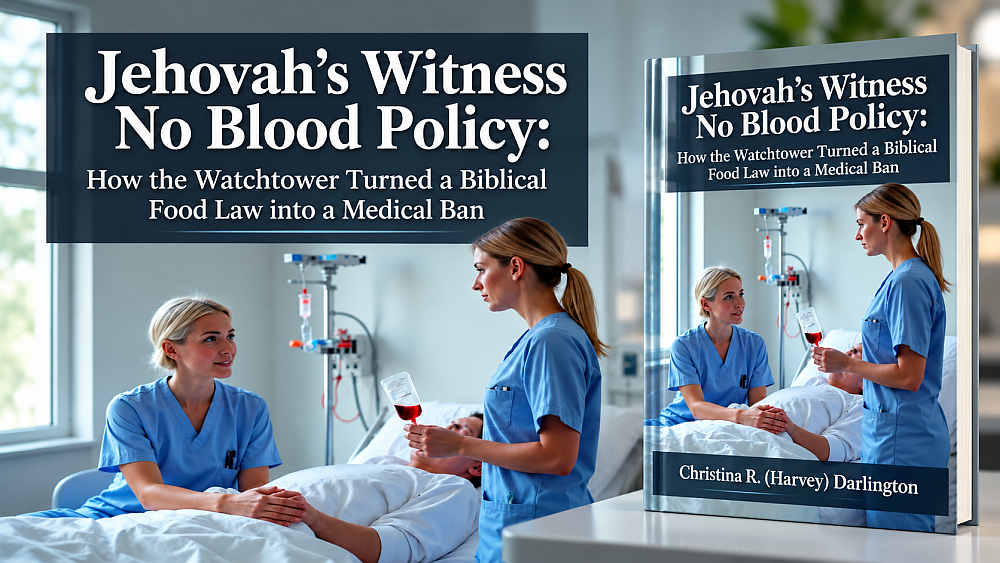
Buy Christy’s Jehovah’s Witness No Blood Policy Book
Enter Your Email to Download Our Free Complementary Guide: Who Gets to Decide What God Has Forbidden?

 WHY JEHOVAH’S WITNESSES DIE RATHER THAN ACCEPT A BLOOD TRANSFUSION
NANCY’S STORY – How the Watchtower Policy On No Blood Transfusions Impacted My Family
DOES GOD’S LAW ON BLOOD REQUIRE NO BLOOD TRANSFUSIONS?—PART I / PART II (NOTE: These Mock Discussions with JWs took place prior to 2026 Major JW blood Transfusion Policy Change)



